
SF Climate Week 2025 Highlights: Wildfire, Insurance and Adaptation Finance
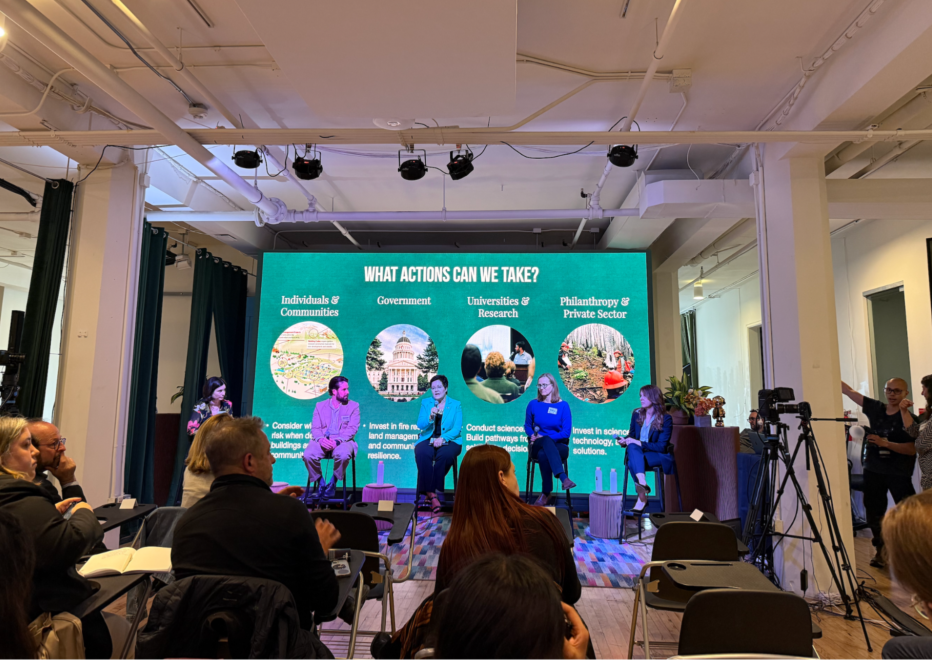
SF Climate Week held its third year of events late last month. With more than 450 sessions, I couldn’t attend them all so I focused my time on three issues of particular relevance based on the interests of the Wildfire Resilience Funders network, as well as the wider focus of the Climate Resilience Fund: wildfire, insurance, and adaptation finance.
Wildfire: Integrated Approaches Applied in Context
There were a number of events over the week that touched on wildfire resilience. The reflections shared across these events emphasized taking an approach that considers the critical roles of scientific understanding, community engagement, and ecosystem management, along with the use of technology. It was the importance of thinking about different approaches in different contexts that emerged for me as one of the key takeaways. Those of us who work on wildfire often delve into the details of strategy, whereas the speakers reminded me that it is also essential to establish up front the type of area being addressed, whether wildland, wildland-urban interface (WUI), or communities as structural fuel. The context of each environment, the stakeholders, policy approaches, fuel sources, and mitigation approaches, amongst other considerations, must be framed specifically and in relation to impacts on one another.
When considering wildland fires, the audience at one event was reminded that half of those that occurred between 2010 and 2020 burned at the proper size and intensity to be beneficial fire for the ecosystem. Speakers noted that as land managers consider various strategies, their work is becoming increasingly complex, as they need to take into account not only the historic effects on ecosystems, but the constantly mounting impacts of climate change and the overlaps between large landscape wildlands and how these landscapes interact with structures in the WUI.
Structure-to-structure fire in communities was top of mind, with references to the LA fires as an example of the devastation that can occur when an ignition at the edge of a community, amplified by the type of extreme conditions associated with climate change, leads to structural fire spread. Speakers talked about the need for the use of integrated approaches to create fire-adapted communities: climate-informed land use planning, building codes, retrofitting and building fire-resistant structures and landscaping, undertaking community planning for risk reduction, and creating a much-needed fire risk index for the built environment are all required.
Repeated references were made throughout the week to the importance of data and technology, which can be applied to create actionable intelligence that can be used to develop those integrated approaches, helping with land management, ignition detection, and strategy development across all environments.
Insurance: Challenges and Some Examples of Hope
Climate risk and extreme weather sessions were underscored by the role of insurance market instability as an indicator of high risk. What role exactly does insurance play in building resilience? The topic of insurance and wildfires was brought to the forefront and often discussed in relation to the LA wildfires. While speakers recognized that insurance needs to price risk, they also noted the challenges for households as their rates rise along with the risk of climate-related impacts. During these conversations, I was reminded that not only are 1 in 13 American homes uninsured, but 37% of American households don’t have $400 in cash on hand for an emergency. The insurance market is facing a significant challenge, and the need for home insurance is greater than ever. I left the conference thinking about three innovative examples that offer me some hope.
- Wildfire Resilience Insurance Pilot: The Nature Conservancy and Willis created an insurance policy for a homeowners association in Tahoe, California that recognizes risk reduction via forest treatments that mitigate wildfire intensity.
- Rebuilding Resiliently in LA: The Resiliency Company and Insurance for Good are working on a program to help low-to-moderate income households rebuild to the highest IBHS Wildfire Prepared Home standard to lower risk and increase the likelihood of obtaining homeowners insurance.
- Climate Resilience District Incubator: CA FWD led an insurance design sprint that resulted in the idea of Climate Resilience Districts. The design sprint brief explained: “Districts are formed by cities, counties, or local governments to pool tax-increment revenues and other financing tools for shared climate adaptation needs, such as wildfire mitigation and flood protection. This regional approach helps reduce long-term public sector fiscal risks and stabilize insurance markets.”
Adaptation Finance
With climate finance, much of the attention to date has been focused on mitigating future damage through the clean energy transition. And while greenhouse gas mitigation remains important, it was welcome to see more attention this week being paid to financing for adaptation actions that can make communities safer and more resilient to climate impacts in the near term.
Adaptation finance focuses on increasing the ability of critical infrastructure and systems to withstand the impacts of extreme weather before disaster strikes. The week’s events touched on water and energy, agriculture, and early warning systems as examples of the areas that adaptation finance seeks to address. While speakers noted the rate of increasing extreme weather and its impact on communities, they emphasized that adaptation projects are still not receiving enough funding. They flagged that recent cuts to federal funding programs, such as FEMA’s Building Resilience in Infrastructure and Communities (BRIC), will only amplify the need for private finance in adaptation. Demonstrating that adaptation actions can lower costs and lessen the effect of extreme weather on people and ecosystems is where strategic philanthropic investments can help to de-risk projects and facilitate opportunities for institutional investors to bring additional capital to the mix.
I was especially interested in a presentation by Tailwind, led by Emilie Mazzacurati, who created an Adaptation and Resilience Innovation Playbook, which brings to life the opportunities they see for an adaptation finance capital stack, which looks across philanthropic capital, household spend, private capital, insurance, disaster risk finance, international public finance, loss and damages, and domestic public finance.
It is clear that building the private sector financial ecosystem for adaptation and resilience will be critical to the work ahead.
Moving forward
Whether in living with fire, improving insurance markets, or expanding adaptation funding, SF Climate Week, with all of its thoughtful speakers and insightful events, made the work for resilience clear. On we go!
Kayla Calkins is the Climate Resilience Fund’s Program Officer for Wildfire Resilience Funders.