
WRF Annual Convening
Agenda | Speakers | Hotel | What to Expect | WRF Home
Annual Convening 2026
June 1-3, 2026 | Ashland, Oregon
The 2020 Labor Day Fires reshaped Oregon’s relationship with wildfire, setting in motion ambitious state-level transformations in wildfire policy, WUI management, and community resilience across the Rogue Valley and beyond. This year’s Wildfire Resilience Funders (WRF) Convening invites you to see that transformation firsthand: what communities have built from the wreckage, and what the next phase of mitigation, partnership, and funding needs to look like.
This is not structured as a typical conference room convening, attendees should come ready to listen and learn in the field. Both days are grounded in site visits and direct conversation with the practitioners, community leaders, and partners doing this work.
Day 1 — Recovery and Resilience: Talent and Phoenix
We’ll spend the first day on the ground in Talent and Phoenix, two of the communities hardest hit by the Alameda Fire. Our visit will explore how resilience became a guiding principle — not just a talking point — in how these communities chose to rebuild. We’ll hear directly about the recovery of housing stock, how federal and state recovery dollars are being leveraged to support local economic recovery, and the intentional work to rebuild the community infrastructure, organizations, and gathering spaces that hold a neighborhood together.
Day 2 — Partnerships and Finance: Scaling Mitigation
The second day zooms out to the bigger question: what does it take to advance wildfire mitigation at the scale and speed the moment demands? A half-day site visit to the Ashland Forest Resiliency Project will bring the complexity of that work into focus, highlighting the coordination required, the funding gaps, and the urgency that practitioners in this space feel every day. We’ll close with a session on an innovative municipal financing mechanism being piloted in the region, with clear implications for wildfire-prone communities across the West.
Who Should Attend? Funder organizations are invited to attend and do not need to be a WRF Member. However, organizations that are a WRF Member will enjoy a discounted rate. The WRF Convening is not open to Affiliates. Learn more about becoming a WRF Member.
Agenda at a Glance
Convening Dates: June 1-3, 2026
Monday, June 1, 2026
- 5:30pm – 7:00pm: Evening Welcome Reception & Dinner
Tuesday, June 2, 2026
- 8:30am – 10:00am: Southern Oregon Wildfire Roundtable
- 10:15am – 11:45am: From Disaster Recovery to Resilience: Innovations in the Rogue Valley
- 12:30pm – 4:30pm: Site Visit to Alameda Fire Recovery
- 5:30pm: Attendee Happy Hour & Dinner with Rogue Food Unites
Wednesday, June 3, 2026
- 8:30am – 1:00pm: Ashland Forest Resiliency Project Site Visit
- 2:15pm- 3:15pm: Regional Wildfire Resilience Financing Mechanisms
- 3:15pm – 4:00pm: Funder Only Closing Session
MONDAY, JUNE 1, 2026
5:30pm – 7:00pm: Evening Welcome Reception & Dinner
7:00pm – 8:00pm: Optional Partner-led event by City of Ashland: CWPP Draft Community Values Research Presentation
TUESDAY, JUNE 2, 2026
The first day of our convening will focus on how Oregon’s wildfire priorities have evolved since the devastating 2020 wildfire season. We’ll set the stage with a grounding conversation on what sparked this transformation, uplifting the work to implement recommendations from an Oregon Wildfire Roadmap that have prepared the State to generate funding and attract significant investment for its wildfire risk mitigation priorities.
We’ll spend the rest of the day in the communities of Talent and Phoenix learning how they have recovered from the 2020 Alameda Fire and the ways in which resilience has been a core theme of their recovery.
8:30am – 10:00am: Southern Oregon Wildfire Roundtable
We’ll begin our programming with a roundtable that tells both the story statewide of how Oregon has translated a 2019 Wildfire Roadmap into actionable priorities for wildfire risk reduction, and uplifts regionally how Ashland the Rogue Valley have long been investing and prioritizing wildfire resilience. This panel will provide attendees with the framing they need to engage in the entire convening with a foundational understanding of the Oregon Wildfire Context.
Speakers:
- Doug Grafe, Oregon Governor’s Office
- Mayor of Ashland, Tonya Graham (moderator)
- Dr. Chris Dunn, Oregon State University
- Marko Bey, Lomakatsi Restoration Project
10:15am – 11:45am: From Disaster Recovery to Resilience: Innovations in the Rogue Valley
The 2020 wildfire season in Oregon was cataclysmic and also catalytic for the State of Oregon’s approach to wildfires. In Jackson County alone they lost 2,500 homes, including more than a dozen manufactured housing neighborhoods. The broad devastation led to transformative outcomes: both in developing policy and community-based infrastructure for recovery and prioritizing planning and funding for pre-fire mitigation that would prevent catastrophic wildfires in the future. In the 6 years since the fires, the Rogue Valley has modeled what complex community recovery can look like, with lessons for funders in other regions supporting recovery. This conversation will provide foundational framing for our site visit.
Speakers:
- Dee Anne Everson, Jackson County United Way & Oregon Community Foundation
- Tucker Teusch, Firebrand Collective
- Oregon State Representative Pam Marsh (invited)
12:00pm – 4:30pm: Alameda Fire Recovery Site Visit
This site visit will take funders across the Rogue Valley following the path of the Alameda Fire to better understand how the fire spread along the Bear Creek Greenway and into the cities of Talent and Phoenix. We’ll learn about innovative efforts to rebuild wildfire resilient neighborhoods, how local governments can reinvigorate local businesses, and how community spaces can be designed to foster connection and resiliency in the aftermath of disaster. The framing of this site visit will focus on how communities can recover with resilience in mind and what funders coming from other geographies can take away from the Rogue Valley.
- Stop One: Talent Maker City
- Stop Two: Talent Mobile Estates
- Stop Three: Phoenix Civic Center
- Stop Four: Blue Heron Park
5:30pm: Attendee Happy Hour & Dinner featuring Rouge Food Unites
WEDNESDAY, JUNE 3, 2026
The final day of our convening will focus on the partnerships needed to advance wildfire mitigation at scale and the complex funding that is required to do the work. We’ll begin with a half-day site visit to hear from unique partnerships across the region to better understand the scale and urgency of the work, followed by a closing panel uplifting innovative financing mechanism being piloted in the region.
8:30am – 1:30pm: Site Visit: Wildfire Resilience Partnerships across the Region
This site visit will take us to several locations within the Ashland Forest Resiliency Project to learn about the complexities of developing partnerships for wildfire mitigation.
- Stop One: Mountain Ranch HOA
- Stop Two: Partnerships across Private Lands (Epstein Property)
- Stop Three: Rogue River-Siskiyou National Forest prescribed fire unit
2:15pm – 3:15pm: Regional Wildfire Resilience Financing Mechanisms
We’ve spent the last two days learning about the transformation of Oregon’s approach to wildfires after the devastating 2020 fire season. We’ve seen the incredible work and partnerships in the region focused on recovery, landscape resilience, and community risk mitigation. This closing panel will offer insights and a new model for how communities generate and sustain funding needed to reduce the risk of catastrophic wildfires.
Speakers:
- Woolsey McKernon, Viridian Ecosystems
- Oregon State Rep. Pam Marsh
- Ashland Mayor Tonya Graham
3:15pm – 4:00pm: Closing Funder-only Session
4:30 – 6:30pm: Optional Partner-led Community Event at White Rabbit: Rogue Rais
(Read the Summary Document from last year’s WRF Annual Convening.)
Al Muelhoefer | Mayor, City of Phoenix
Alli French | Executive Director and Co-Founder, Talent Maker City
Alex Campbell | City Manager (invited), City of Talent
Amber Ferguson | Executive Director / CEO, Rogue Food Unites
Belinda Brown| Tribal Liaison, Lomakatsi Restoration Project
Dr. Bill and Sarah Epstein | Private Landowners
Brian Barr | Executive Director, Rogue River Watershed Council
Brian Hendrix | Fire Adapted Communities Coordinator, Ashland Fire and Rescue
Carolyna Marshall | Board Chair, Community Outreach Coordinator, and Community Dinner POD Leader (invited)
Chamise Kramer| Public Affairs Officer, Rogue Siskiyou National Forest
Chris Chambers | Forestry/Wildfire Division Chief, Ashland Fire and Rescue
Chris Dunn, Ph.D. | Oregon State University, Oregon State University
Darby Ayers-Flood | Mayor (invited), City of Talent
Dee Anne Everson | CEO and Board Member, Jackson County United Way & Oregon Community Foundation Board
Doug Grafe | Wildfire Programs Director, Oregon Governor’s Office
Doug Kay | Firewise Communities Leader, Mountain Ranch Homeowners Association
Jason Elzy | Executive Director (invited), Jackson County Housing Authority
Erin Beard | Programs Director, Talent Maker City
Senator Jeff Golden | Oregon State Senator, Oregon State Legislature
Jane Jimerfield| Program Director, Lomakatsi Restoration Project
Jocksana Corona | Promoter of Justice and Defense of Housing and Notary (invited), Coalición Fortaleza
Katharine Cato | Travel Ashland Director, Travel Ashland
Kerry Metlen| Senior Forest Scientist, The Nature Conservancy
Marko Bey | Executive Director and Founder, Lomakatsi Restoration Project
Marta Tarantsey | Regional Development Officer (invited), Business Oregon
Mark Shay | Deputy Chief, Ashland Fire and Rescue
Marty Main| Forester, Small Woodland Services
Molly Morison | Co-Founder and Grower, Upper Five Vineyard
Representative Pam Marsh | Oregon State Representative, Oregon State Legislature
Peter Winnick| District Conservationist, USDA Natural Resources Conservation Service
Terry Sullivan | Owner (invited), Upper Five Vineyard
Terry Fairbanks | Executive Director, Southern Oregon Forest Resilience Collaborative
Tonya Graham | Mayor and Executive Director, City of Ashland / Geos Institute
Tucker Teutsch | Founder and Executive Director, Firebrand Resiliency Collective
Teresa Cisneros | Interim Executive Director (invited), Coalición Fortaleza
Woolsey McKernon | Head of Capital Markets, Viridian Ecosystems
Zac Moody | Community Development Director (invited), City of Phoenix
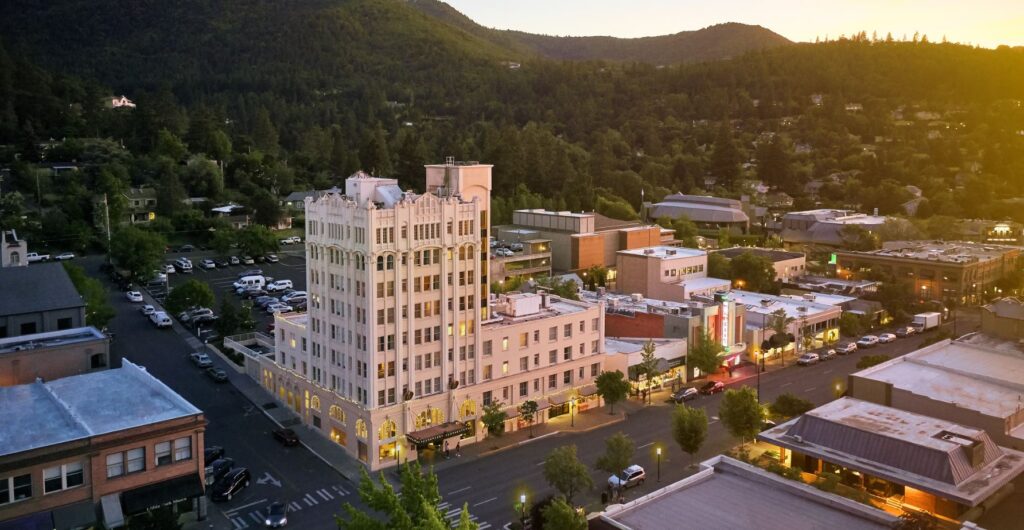
The Ashland Springs Hotel
Our meeting and accommodations will be hosted at the historic Ashland Springs Hotel in beautiful downtown Ashland. WRF has secured a discounted room block for attendees. Please book your hotel rooms as quickly as possible using WRF’s discounted group rate. We recommend doing so soon, as the popular Ashland Shakespeare Festival’s opening week aligns with our convening.
What to Expect at the Meeting
Attendees can expect to engage with place-based learning opportunities and local practitioners that offer insight into scalable solutions for wildfire resilience across both the built environment and in diverse landscapes. Panels will feature regional experts, funder partners, and community leaders who will share their experiences designing and implementing resilience strategies across Southern Oregon. The planned site visits will offer an opportunity for funders to see the work that is being done on the ground, while giving space for attendees to consider how these innovations might be applicable in geographies they currently fund.
Information about Attending
Who Should Attend
Funder organizations are invited to attend and do not need to be a WRF Member. However, organizations that are a WRF Member will enjoy a discounted rate. Learn more about becoming a WRF Member.
The WRF Convening is not open to Affiliates.
Cost for WRF Members is $300; cost for non-WRF Members is $650.
Hotel Information
Please book your rooms at the Ashland Springs Hotel as soon as possible. The historic Ashland Springs Hotel is located in downtown Ashland, surrounded by shops, restaurants, coffee shops, and outdoor recreation options. The hotel offers complimentary, gated parking for hotel guests. Your reservation will include breakfast at the hotel.
Travel Information
Ashland is conveniently located off Interstate-5 for those located along the West Coast who wish to drive. It is around a 5 hour drive from both the San Francisco Bay Area and Portland.
Transportation
The nearest airport to Ashland is the Rogue Valley International Medford Airport, which is service by direct flights from San Francisco, LA, Orange County, San Diego, Seattle, Portland, Denver, Salt Lake City, Las Vegas, and Phoenix. The airport is approximately 21 minutes from Ashland Springs Hotel. Ground transportation to Ashland is available by taxi, Uber, Lyft, and rental car.
Visiting Ashland
Travel Ashland has graciously sponsored a welcome bag for WRF convening attendees that will offer travel guides for the local community. Our annual convening aligns with the opening week of the outdoor theatre at the Ashland Shakespeare Festival so it will be a lively time in the city.
Food
Breakfast is included with your hotel reservation. WRF will provide group lunches and dinners all days during the meeting to give participants maximum time to network with funder colleagues.
Dress & Attire
Please dress comfortably as both full convening days will include a partial day site visit. Bring shoes for walking, water bottle, and a hat for the sun. Temperatures in the region can vary in early June, and we’ll have a better sense of the forecast closer to the convening dates.