CSCI Grants
Climate Smart Communities Initiative (CSCI)
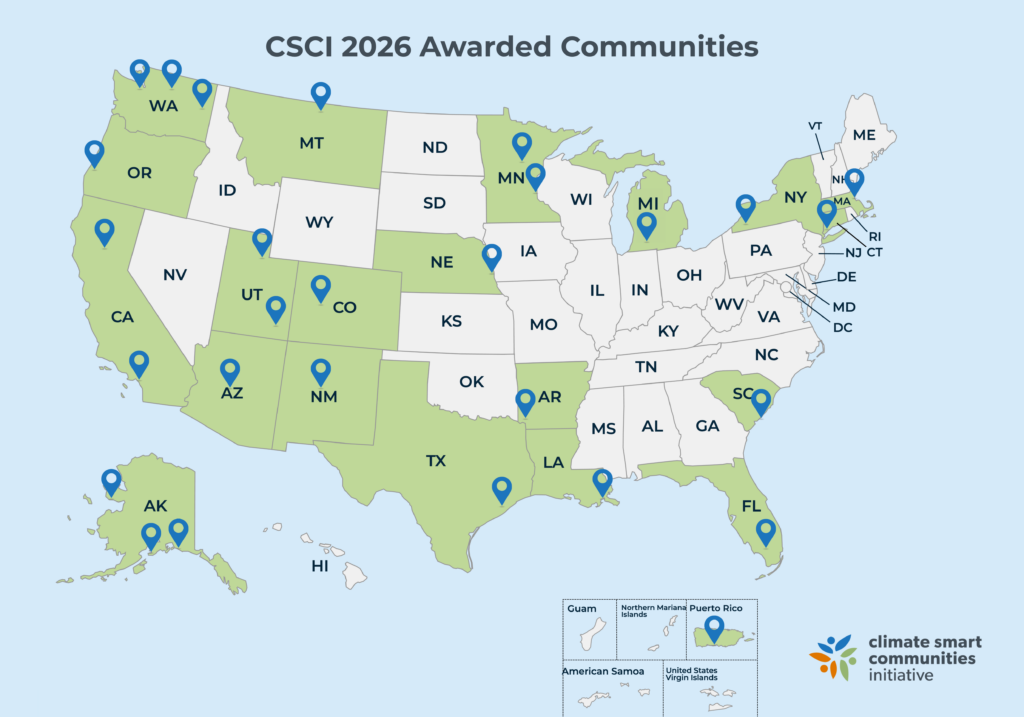
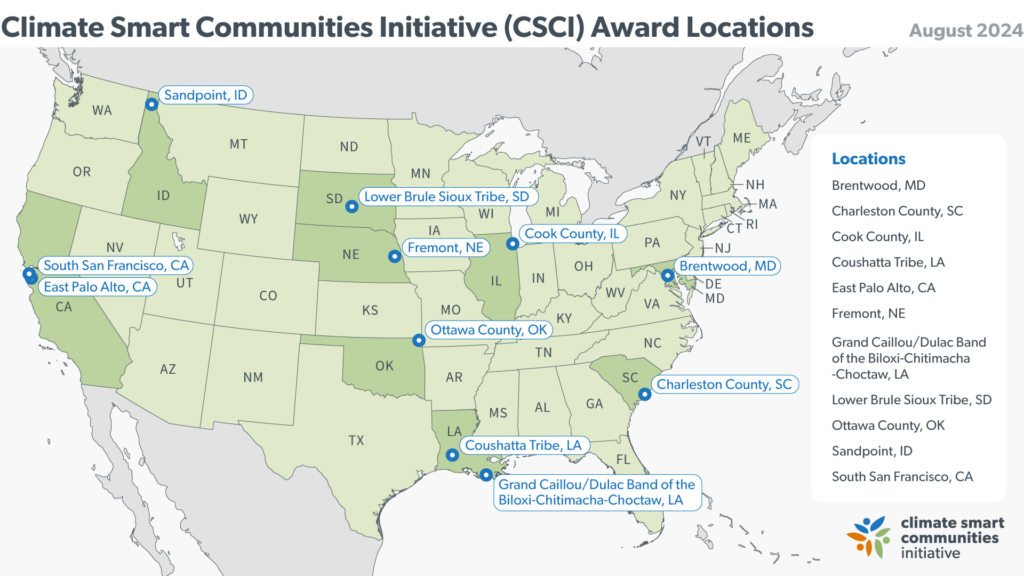
The Climate Resilience Fund (CRF) is the institutional hub for the Climate Smart Communities Initiative (CSCI). CSCI provides practitioner training opportunities, grants and technical support, and cohort support to adaptation experts that work with communities on climate resilience planning or projects. The list below includes awarded communities in each year and denotes the community or region where their work is focused.
2026
Alaska: Building Regional Food Security and Resilience in the Bering Strait Region
Recipient: Model Forest Policy Program, Inc.
Project Partners: Model Forest Policy Program, Kawerak, Native Villages of Teller, Mary’s Igloo, and Elim
This project will establish Pilgrim Hot Springs as a regional Community Resilience Hub to strengthen food security across the Bering Strait Region. The team will achieve long-term regional capacity for resilience by creating a Village Food Network and knowledge sharing of nature-based streambank restoration. Core partners, including Model Forest Policy Program, Kawerak, and the Native Villages of Teller, Mary’s Igloo, and Elim, will lead this effort for Alaska native villages facing critical hazards like coastal erosion, extreme storms, and shifting ecosystems that threaten traditional subsistence resources. Nearly $115,000 will provide funding, at minimum, for the native villages of Teller, Mary’s Igloo, Elim, and Kawerak, to foster geothermal agricultural practices, and knowledge sharing to ensure stable, local food distribution.
Contact: Margaret Hall, Associate Director, Model Forest Policy Program, Inc.
Alaska: Securing Cordova’s Water Future Through Collaborative Climate Resilience
Recipient: Prince William Sound Science Center
Project Partners: Prince William Sound Science Center, City of Cordova, the Native Village of Eyak, and the Prince William Sound Economic Development District
The fishing community of Cordova, Alaska, will use this $115,000 grant to build resilience against climate-driven hydrology shifts, including declining snowpack and increasing drought. Funding will support a comprehensive freshwater demand analysis and the modeling of seasonal supply vulnerabilities. To secure long-term freshwater stability and prevent severe summer shortages, the project will also evaluate nature-based and technological solutions, such as beaver dam analogs and snow fencing. Led by core partners the Prince William Sound Science Center, the Prince William Sound Economic Development District, the City of Cordova, and the Native Village of Eyak, the initiative aims to merge freshwater demand analyses, advanced hydrologic modeling, and evaluations of nature-based and technological solutions with community insights to equitably safeguard the local economy and subsistence way of life.
Contact: Marysia Szymkowiak, Director of Coastal Resilience, Prince William Sound Science Center.
Alaska: Advancing Tribally-Led Regional Climate Resilience for the Chugach and Lower Cook Inlet Tribes
Recipient: PICEA Consulting Group
Project Partners: PICEA Consulting Group, Chugach Regional Resources Commission (CRRC), Native Village of Port Graham Tribal Council
This project will strengthen Tribal climate resilience planning across the Chugach and Lower Cook Inlet region through a Tribally led, community-driven planning process. PICEA Consulting Group, the Chugach Regional Resources Commission (CRRC), and the Native Village of Port Graham Tribal Council will work with participating Tribes to develop a Regional Climate Change Strategic Plan. The project partners will examine climate-related challenges including shifting species and ecosystems, coastal hazards, and changing seasonal patterns affecting subsistence resources and community wellbeing. The $115,000 grant will support community listening sessions, Elder-focused community knowledge sharing, Traditional Ecological Knowledge documentation, a climate vulnerability assessment, and updates to the Chugach Region Tribal Conservation District governance structure to strengthen long-term regional climate coordination.
Contact: Chas Jones, Chief Executive Officer, PICEA Consulting Group.
Arizona: Cooling Phoenix’s Sunnyslope Neighborhood through the Water for Shade Project
Recipient: Resilient Cities Catalyst
Project Partners: Resilient Cities Catalyst, City of Phoenix Office of Heat Response and Mitigation, Unlimited Potential
The Water for Shade project will address extreme heat in the Sunnyslope neighborhood of Phoenix, Arizona. The initiative will scale nature-based cooling solutions by assessing the feasibility of a whole-of-community green district focused on this heat-vulnerable community. Resilient Cities Catalyst, the City of Phoenix Office of Heat Response and Mitigation, and Unlimited Potential will collaborate as core partners to develop an implementation roadmap and explore sustainable financing models for tree canopy expansion. This $115,000 grant award will culminate in an actionable plan for place-based greening, including pilot tree plantings and innovative irrigation systems, ultimately reducing the public health risks of extreme temperatures by creating a more connected and shaded urban corridor.
Contact: Anna Friedman, Director of Policy & Programs, Resilient Cities Catalyst.
Arkansas: Building Community-Driven Watershed Resilience in Fulton, McNab, Stamps, and Lewisville
Recipient: Environmental Equity Information Institute
Project Partners: Environmental Equity Information Institute, Visibility Outreach Touch Engage South Arkansas (VOTE SoAR), Town of Fulton Council
The Environmental Equity Information Institute will partner with several partners, including Visibility Outreach Touch Engage South Arkansas (VOTE SOAR) and the Town of Fulton Council to advance community-driven watershed resilience. The $115,000 project will develop a community-endorsed flood resilience roadmap and a regional peer exchange program between the towns of Fulton, McNab, Stamps, and Lewisville by integrating technical flood exposure analysis with community-led participatory mapping and data literacy training. These interventions aim to co-design actionable climate solutions and empower residents to transition from passive information recipients to active agents of change, ultimately reclaiming resilience through community-driven watershed planning and collaborative regional engagement.
Contact: Louise Palmer, Executive Director, Environmental Equity Information Institute.
California: Building Community-Led Climate Resilience in Mineral and Mill Creek
Recipient: Sierra Institute for Community and Environment
Project Partners: Sierra Institute for Community and Environment, South Lassen Watersheds Group, Mineral and Mill Creek Communities
The Sierra Institute and its partners within the South Lassen Watersheds Group will work together to help the Mineral and Mill Creek communities prepare for future wildfire and other climate impacts. Through collaboration with residents, Tribal partners, and technical experts, the project will build a shared vision for protecting and restoring the landscape. Supported by a $100,000 grant, the partners will establish four working groups and work with them to develop a Community-Guided Implementation and Adaptation Plan that identifies restoration priorities, protects water resources, supports healthier forests, and creates a clear path toward implementation and funding.
Contact: Bella Bledsoe, Director of Collaborative Engagement, Sierra Institute for Community and Environment.
California: Advancing Indigenous-Led Climate Resilience and River Restoration in the Santa Ana Watershed
Recipient: American Rivers
Project Partners: American Rivers, Orange County Environmental Justice Education Fund, Gabrieleño/Tongva San Gabriel Band of Mission Indians, Juaneño Band of Mission Indians, Acjachemen Nation-84A, Juaneño Band of Mission Indians Acjachemen Nation-Belardes
This grant will mobilize a collaboration among American Rivers, the Orange County Environmental Justice Education Fund, the Gabrieleño/Tongva San Gabriel Band of Mission Indians, the Juaneño Band of Mission Indians, Acjachemen Nation-84A, and the Juaneño Band of Mission Indians Acjachemen Nation – Belardes to partner on an ambitious Indigenous-led climate resilience project. The $115,000 grant will enable the project partners to develop aquatic and terrestrial restoration designs on the Santa Ana River. This work will focus on the Acjachemen and Tongva Nations and historically disinvested communities in Orange County, California, targeting critical climate hazards, including drought, riverine flooding, and shifting ecosystems. This initiative will employ nature-based solutions and use Indigenous Ecological Knowledge to design de-channelized waterways and restore floodplain ecosystems to improve groundwater quality and mitigate extreme heat.
Contact: Patricia Flores, Associate Director, American Rivers.
Colorado: Co-Developing a Resilience Plan for Carbondale’s Water Future
Recipient: Headwaters Climate
Project Partners: Headwaters Climate, Clean Energy Economy for the Region (CLEER), Lukas Climate, Town of Carbondale
A grant of $109,000 will support a collaborative effort between Headwaters Climate, Clean Energy Economy for the Region (CLEER), Lukas Climate, and the Town of Carbondale to address the impacts of drought, increased wildfire risk, and declining snowpack. The project will develop a plan to secure water and wastewater systems, with a priority on serving historically disinvested populations. Partners will work with the community to co-develop the Carbondale Inclusive Resilience Utilities Plan, which will guide approximately $160 million in future infrastructure investments. These interventions will integrate localized climate modeling with direct community input to identify equitable solutions and essential upgrades, ultimately ensuring water security and long-term resilience for the town’s snowpack-dependent water and wastewater utilities.
Contact: Colin Quinn, Founder, Headwaters Climate.
Connecticut: Advancing Shoreline Resilience in Bridgeport’s West Side
Recipient: Trust for Public Land
Project Partners: Trust for Public Land, PT Partners, City of Bridgeport’s Office of Sustainability
This $115,000 grant will fund a coastal resilience project led by Trust for Public Land, PT Partners, and the City of Bridgeport’s Office of Sustainability. Partners will conduct a comprehensive feasibility study to address air quality impairments, extreme heat, poor water quality, and rising sea levels in Bridgeport’s West Side neighborhood. By leveraging years of grassroots resident organizing and aligning with the community’s broader vision for a 20-mile Waterfront Seawalk, this project will refine community-driven resilience objectives and prioritize options for nature-based shoreline interventions, creating a more sustainable and equitable future for the neighborhood.
Contact: Max Gray, Institutional Giving Director, Trust for Public Land.
Florida: Advancing Miccosukee Tribal Climate Resilience in the Everglades
Recipient: Adaptation International
Project Partners: Adaptation International, Miccosukee Tribe of Indians of Florida, Love The Everglades Movement, Just Collective
The Miccosukee Tribe of Indians of Florida will partner with Adaptation International, Love The Everglades Movement, and Just Collective to enhance community wellness. This project will use the $114,600 grant to host a series of creative participatory workshops to broaden the discussion of climate related risks and responses to the entire community, providing space for multi-generational knowledge sharing and discussing the lived experiences of climate change. The community will co-develop education, outreach, and action toolkits at the family and village scales to prepare for two of the most pressing hazards in the Everglades: extreme heat and flooding.
Contact: Sascha Petersen, Director, Adaptation International.
Louisiana: Translating Local Knowledge to Create a Climate Adaptation Roadmap for New Orleans’ 17th Ward
Recipient: EcoAdapt
Project Partners: EcoAdapt, City of New Orleans Office of Resilience and Sustainability, Hollygrove-Dixon Neighborhood Association
This project will use a $98,500 CSCI grant to support baseline climate research, community forums, risk analysis, and surveys. In partnership with EcoAdapt, the City of New Orleans Office of Resilience and Sustainability, and the Hollygrove-Dixon Neighborhood Association, the initiative focuses on the historically disinvested Gert Town, Hollygrove, and Hollygrove-Dixon neighborhoods in New Orleans’ 17th Ward. The work will address priority climate hazards and impacts, including flooding, extreme heat, and severe storms that threaten aging infrastructure and resident safety. To address these challenges, partners will co-develop a community-informed adaptation roadmap that prioritizes nature-based solutions. The project’s emphasis on translating residents’ lived experiences into practical steps will directly embed equity and community ownership in local climate planning.
Contact: Kathryn Braddock, Lead Scientist, EcoAdapt.
Massachusetts: Building a Community-Led Climate Resilience Framework in Lynn, Massachusetts
Recipient: Emerald Cities Collaborative
Project Partners: Emerald Cities Collaborative, Latino Support Network, City of Lynn Planning Department
This grant will provide $115,000 to develop a community-led Climate Resilience Framework focused on historically disinvested neighborhoods in the city of Lynn. The core partners, Emerald Cities Collaborative, Latino Support Network, and the City of Lynn Planning Department, will address priority climate hazards, including extreme heat, inland and coastal flooding, and sea level rise. To build long-term resilience, the partners will launch a sustained community climate coalition and a resident climate action cohort. This core activity will integrate local voices to translate community priorities into actionable municipal solutions.
Contact: Esmeralda Bisono, Northeast Climate Resilience Manager, Emerald Cities Collaborative.
Michigan: Building Resilience in Kalamazoo’s Edison Neighborhood
Recipient: EcoAdapt
Project Partners: EcoAdapt, Kalamazoo Climate Crisis Coalition, Kalamazoo County, and the Kalamazoo County Land Bank
A $115,000 grant will support a collaborative effort among the Kalamazoo Climate Crisis Coalition, EcoAdapt, Kalamazoo County, and the Kalamazoo County Land Bank to address extreme heat, flooding, and water quality impacts threatening the Edison Neighborhood in Kalamazoo, Michigan. The project will implement a block-scale climate resilience pilot that integrates nature-based stormwater infrastructure with housing rehabilitation in this historically disinvested community. The primary activities include installing green infrastructure, such as rain gardens and bioswales, as well as home energy efficiency and solar upgrades on County Land Bank-controlled properties. These interventions aim to co-create a scalable model for flood-resilient, climate-smart neighborhood design, transforming vacant lots into community assets that enhance long-term resilience and equity.
Contact: Kathryn Braddock, Lead Scientist, EcoAdapt.
Minnesota: Developing Actionable Neighborhood Resilience Solutions in Payne-Phalen
Recipient: WSB
Project Partners: Payne-Phalen Community Council, City of St. Paul, Environmental Initiative, WSB
The Payne-Phalen Community Council, the City of St. Paul, Environmental Initiative, and WSB will partner to advance climate resilience in the multicultural neighborhood of Payne-Phalen, St. Paul, Minnesota. Payne-Phalen faces significant climate impacts from extreme heat, poor air quality, and severe weather. To build long-term resilience, the partners will create a prioritized Resilience Playbook. In addition to the Playbook, CSCI funds will be used to create a neighborhood-scale portfolio of projects, conduct inclusive multilingual community outreach, and design funder-ready project proposals for future public, private, and philanthropic investments. This work will build on trusted, community-led support networks to directly translate city-wide climate assessments into actionable, culturally rooted neighborhood solutions.
Contact: Katie Baum, Senior Sustainability Planner, WSB.
Montana: Enhancing Rangeland Resilience and Water Security for the Fort Belknap Indian Community
Recipient: Lark Environmental, Inc.
Project Partners: Lark Environmental, Inc., Fort Belknap Indian Community (FBIC) Land Department, Aaniiih Nakoda College, FBIC Environmental Department
A grant of $110,775 will support a collaborative effort between Lark Environmental, the Fort Belknap Indian Community (FBIC) Land Department, Aaniiih Nakoda College, and FBIC Environmental Department to address persistent drought, extreme heat, and water quality impacts threatening the Fort Belknap Indian Reservation. The project will focus on enhancing climate resilience across 700,000 acres of rangelands, prioritizing historically underserved Tribal agricultural producers. Key activities will include conducting a comprehensive, reservation-wide stockwater assessment and maintenance systems, and streambank protection plans. These interventions are designed to secure long-term grassland health, mitigate the stress on livestock water systems, and restore degraded riparian habitats for the Gros Ventre and Assiniboine Tribes.
Contact: Juli Ann McNutt, Adaptation Practitioner, Lark Environmental, Inc.
Nebraska: Rooted in North Omaha: Integrating Regenerative Land Practices and Climate Resilience
Recipient: Verdis Group
Project Partners: Verdis Group, Comunidad Maya Pixan Ixim, and the Papio-Missouri River Natural Resources District
The “Rooted in North Omaha” project will focus on the Maya community and leaders from the greater North Omaha region. Core partners include the Verdis Group, Comunidad Maya Pixan Ixim, and the Papio-Missouri River Natural Resources District. Together, they will collaborate to address climate hazards: extreme heat, flooding, and poor air quality. The $96,440 grant will support the development of a community-led climate resilience plan that will integrate nature-based strategies to safeguard transportation infrastructure along the Beltline Trail corridor. Maya-led regenerative land practices will complement the planned regional trail infrastructure, elevating climate resilience planning in a historically redlined urban neighborhood.
Contact: Grace Thomas, Verdis Group, Manager of Sustainability Services.
New Mexico: Advancing Neighborhood Resilience in the South Valley and International District of Albuquerque
Recipient: Spatial Informatics Group Natural Assets Laboratory (SIG-NAL)
Project Partners: Spatial Informatics Group Natural Assets Laboratory (SIG-NAL), Ciudad Soil and Water Conservation District, Bernalillo County, Tree New Mexico
This project will utilize a $115,000 CSCI grant to formalize the Rain to Roots program, a community-centered initiative dedicated to expanding passive rainwater harvesting. Core partners, including Spatial Informatics Group Natural Assets Laboratory (SIG-NAL), Ciudad Soil and Water Conservation District, Bernalillo County, and Tree New Mexico, will focus their efforts on historically disinvested populations in Albuquerque’s South Valley and International District. The work will address extreme heat, drought, and flooding. The team will conduct hands-on education and installation workshops that teach volunteers to create earthworks like bioswales and rain gardens towards greater environmental and social resilience. These solutions will capture stormwater to irrigate native trees, cooling neighborhoods, and protecting vital water resources.
Contact: Shelby Stimson, Resilient Cities Program Manager, Spatial Informatics Group Natural Assets Laboratory (SIG-NAL).
New York: Co-Developing a Climate Adaptation Plan for the Seneca Nation
Recipient: VIRGA Tribal Solutions LLC
Project Partners: Seneca Nation, VIRGA Tribal Solutions LLC, Just Collective
The Seneca Nation, in partnership with VIRGA Tribal Solutions LLC and Just Collective, has been awarded $115,000 to co-develop a Climate Adaptation Plan rooted in Seneca values and culture. This project integrates climate science with traditional ecological knowledge to address the urgent threats of extreme heat, flooding, and shifting ecosystems to Seneca infrastructure, food systems and community health. Partners will collaborate to create an implementation-ready roadmap ensuring climate adaptation strategies honor intergenerational responsibilities and long-term resilience for the community.
Contact: Jennifer Santry, Chief Executive Officer, VIRGA Tribal Solutions LLC
Oregon: Updating the Coos Bay Estuary Management Plan for Coastal Climate Resilience
Recipient: Sea & Shore Solutions, LLC
Project Partners: Coos County, the Coos Watershed Association, Sea & Shore Solutions
This $115,000 grant will support ongoing efforts to update the Coos Bay Estuary Management Plan, a multi-jurisdictional regulatory document that establishes policies to manage and use Oregon’s Coos Estuary. The plan will, in part, address coastal erosion, sea level rise, flooding, and ecosystem shifts. Collaborative partners including Coos County, the Coos Watershed Association, and Sea & Shore Solutions will focus on community education and engagement and developing an updated aquatic boundary map. A central feature of the project is a robust, inclusive strategy to empower marginalized communities to actively engage in local land use policy development.
Contact: Adrian Laufer, Chief Executive Officer, Sea & Shore Solutions, LLC.
Puerto Rico: Advancing Climate Adaptation and Blue- X Green Infrastructure Strategies for Barrio Tibes
Recipient: Urban Hydrologics, LLC
Project Partners: Junta Comunitaria Pastillo Tibes Corp., Autonomous Municipality of Ponce, Urban Hydrologics
This project will support the rural community of Tibes in Ponce, Puerto Rico, to address extreme precipitation, hurricanes, and storms that trigger landslides, flooding, erosion, and their impacts on the decentralized drinking water system. In partnership with Junta Comunitaria Pastillo Tibes Corp., the Autonomous Municipality of Ponce, and Urban Hydrologics, the project will combine community engagement, geospatial-informed watershed analysis, and a vulnerability assessment to develop a Climate Adaptation and Blue-Green Infrastructure Master Plan. This plan will identify nature-based adaptation opportunities, water-resource management strategies, community and ecological co-benefits, and future pathways for funding, technical support, and other implementation opportunities beyond the grant period. Notably, the $115,000 grant supporting the project will leverage an opportunity to connect climate adaptation directly to a locally managed water system serving 200 families.
Contact: PJ Santa, Director, Urban Hydrologics, LLC.
Texas: Building the Alief Nature Network for Equitable Climate Resilience
Recipient: Resilient Cities Network
Project Partners: AliefVotes, Resilient Cities Network, City of Houston
This project will establish the Alief Nature Network, a collaboration that will mobilize to address the impacts of extreme heat, flooding and poor air quality facing the diverse, historically disinvested community of Alief in Houston, Texas. Alief is facing a combination of climate-related risks, including extreme heat, flooding, and poor air quality. The $115,000 grant will enable core partners AliefVotes, Resilient Cities Network, and the City of Houston to plan and implement nature-based pilot projects and integrate them into a network of rain gardens, pocket prairies, and urban tree plantings. The initiative will enable residents to steward climate interventions through placemaking workshops and civic science programs to create a community-informed adaptation roadmap. Ultimately, this work will create a scalable model for neighborhood resilience that cools the environment and manages stormwater.
Contact: James Neimeister, Communications Associate, Resilient Cities Network.
Utah: Implementing a Circular Carbon System in Park City and Summit County
Recipient: Circular Spring
Project Partners: Circular Spring, Park City Municipal Corporation, Summit Land Conservancy
This project will design a regional circular carbon system to address the escalating threats of wildfire, drought, and extreme precipitation in Park City and Summit County, Utah. The awarded $108,000 will enable core partners – Circular Spring, Park City Municipal Corporation, and Summit Land Conservancy – to identify the partners, feedstocks, technologies, and financial frameworks necessary to establish a community-scale biochar system. The project will assess the conversion of local biomass waste into biochar to enhance soil health and water retention. This nature-based solution will reduce hazardous wildfire fuels and strengthen landscape resilience to address prolonged drought while focusing on benefits for primary residents, seasonal workforce communities, and rural agricultural families.
Contact: Korina Stark, Founding Partner, Circular Spring.
Utah: Enhancing Watershed Resilience through Community-Scale Biochar Production in San Juan County
Recipient: Circular Spring
Project Partners: San Juan County, ProgramEarth, Circular Spring
In a collaborative effort, San Juan County, ProgramEarth, and Circular Spring will tackle critical challenges related to impaired water quality, extreme precipitation, and drought. The project will focus on rural communities in San Juan County, Utah, including Bluff, Blanding, and chapters of the Navajo Nation and Ute Mountain Ute Tribe White Mesa. The $115,000 CSCI award will support nature-based soil restoration by transforming invasive riparian biomass into locally produced biochar and integrating it with compost to enhance soil water retention. The project will bridge environmental monitoring tools with traditional ecological knowledge to ensure long-term, community-led land stewardship.
Contact: Korina Stark, Founding Partner, Circular Spring.
Washington: Assessing Climate Vulnerabilities on the Kalispel Reservation
Recipient: University of Washington Climate Impacts Group
Project Partners: Kalispel Tribe, University of Washington Climate Impacts Group, Kalispel Public Works Advisory Committee
The Kalispel Tribe, the University of Washington Climate Impacts Group, and the Kalispel Public Works Advisory Committee will collaborate to address critical water-related climate hazards focusing on the Kalispel community. The project will address urgent climate-related impacts including flooding, drought, and stormwater infrastructure degradation. The $115,000 CSCI grant will support staff coordination and data collection to complete a Drought, Flood, and Stormwater Vulnerability Assessment for the protection of critical infrastructure and natural habitats. By integrating localized community outreach, the project will align future climate investments with Kalispel values.
Contact: Anne Thebo, Research Scientist, University of Washington, Climate Impacts Group.
Washington: Climate Change Vulnerability Assessment of Culturally Important Plants and Ecosystems in the Kitsap Peninsula
Recipient: Haven Ecology and Research LLC
Project Partners: Great Peninsula Conservancy, Port Gamble S’Klallam Tribe, Suquamish Tribe, Haven Ecology and Research LLC
This $114,000 grant award will support a collaboration between Great Peninsula Conservancy, the Port Gamble S’Klallam Tribe, the Suquamish Tribe, and Haven Ecology and Research LLC. This project will evaluate drought, extreme heat, and shifting ecosystem impacts affecting the Coast Salish communities in Kitsap County and Jefferson County. Upland ecosystems and culturally important plants are experiencing severe stress, threatening traditional medicines, food, and other natural resources central to the commerce, sustenance, and ceremony of the Tribes. To address these impacts, partners will perform a sector-based natural resources assessment, utilizing quantitative spatial analysis and field-based ground-truthing to identify potential climate refugia. Traditional ecological knowledge systems will be interwoven with advanced data science workflows, directly empowering Tribal communities to preserve vital native ecosystems for future generations.
Contact: Dylan Mendenhall, Principal Ecologist, Haven Ecology and Research LLC.
Washington: Developing a Wildfire Adaptation Toolkit for the Town of Winthrop
Recipient: The Keystone Concept
Project Partners: The Keystone Concept, Fire Adapted Methow, Town of Winthrop
The Town of Winthrop, Washington, is experiencing changing seasonality, prolonged periods of drought, and escalating wildfire risk. The project team and local stakeholders will utilize CSCI funding to develop and pilot a Fire Resiliency Toolkit and collaborative governance model for rural townscapes that are confronting accelerating climate challenges at the wildland-urban interface. The Toolkit, governance model, and implementation templates developed through this effort will guide the Town of Winthrop toward health and resilience and provide a replicable, equitable model for rural, amenity-dependent communities across the United States. The project team includes The Keystone Concept, Fire Adapted Methow, and the Town of Winthrop.
Contact: Lance Davisson, Owner, The Keystone Concept.
2025
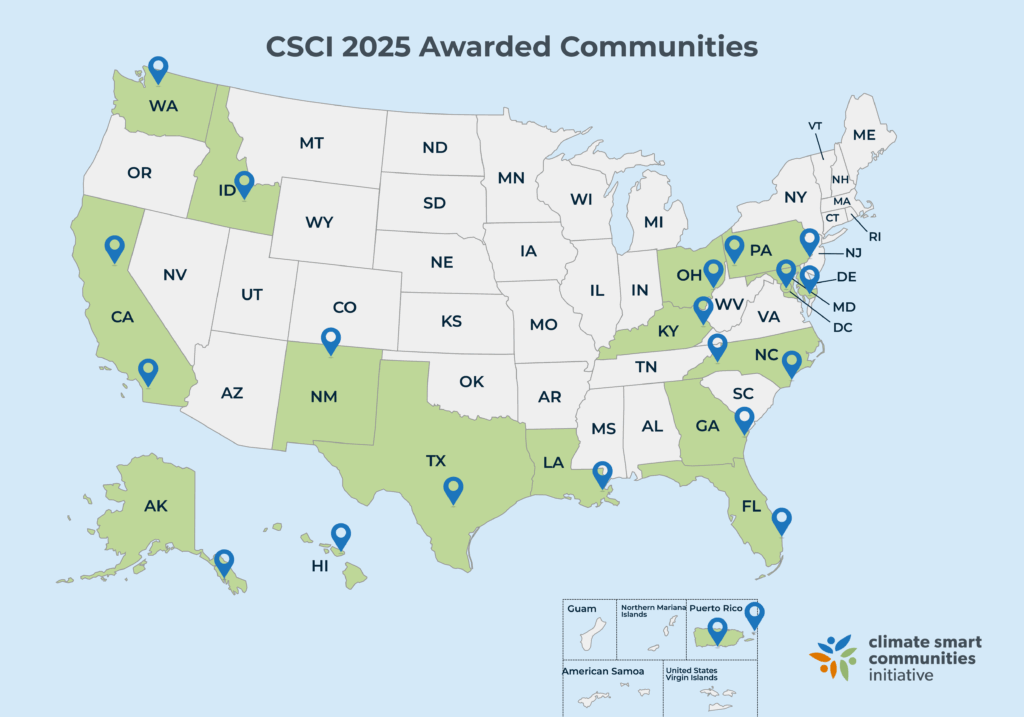
Progress updates are available at the midpoint of the 2025-2026 grant period.
Alaska: Keex Kwaan Climate Change Adaptation Plan
Recipient: Figus Consulting Services, LLC
Project Partners: Organized Village of Kake Tribe; Spruce Root
Southeast Alaska is experiencing increasing extreme weather events and new patterns as the climate changes, notably with periods of drought followed by intense rainfall. Residents in the Keex Kwaan Community Use Area, which surrounds the community of Kake on Kupreanof Island, are especially vulnerable, as this majority Alaska Native community is geographically isolated and historically underserved. This grant will make it possible for the project team to develop a comprehensive climate adaptation plan for Keex Kwaan that emphasizes outreach, education, and food sovereignty. The project team includes the Organized Village of Kake Tribe; community development organization Spruce Root; and climate adaptation practitioner Figus Consulting Services, LLC.
Contact: Elizabeth Figus, Owner, Figus Consulting Services, LLC.
California: Piloting Floodplain Restoration with the Achaemen and Tongva Nations
Recipient: American Rivers
Project Partners: Juaneño Band of Mission Indians; Acjachemen Nation – Belardes; Juaneño Band of Mission Indians; Acjachemen Nation – 84A; Gabrieleno/Tongva San Gabriel Band of Mission Indians; Orange County Environmental Justice Education Fund (OCEJEF); Friends of Puvungna
The Indigenous and low-income communities of Orange County, California disproportionately bear the burden of escalating climate impacts, which include rising temperatures and extreme heat events, and increased risk of drought and flood. With this grant, the Juaneño Band of Mission Indians, Acjachemen Nation – Belardes, the Juaneño Band of Mission Indians, Acjachemen Nation – 84A, and the Gabrieleno/Tongva San Gabriel Band of Mission Indians will work together with Orange County Environmental Justice Education Fund (OCEJEF), Friends of Puvungna, and American Rivers, to design a pilot floodplain restoration project that promotes collaborative stewardship, engages local residents, and identifies solutions that can be applied throughout the region.
Contact: Patricia Flores, Associate Director, American Rivers.
California: Reducing Wildfire Risk in Nevada County with Community Crews and Nature-based Solutions
Recipient: Sierra Streams Institute
Project Partners: California Heritage Indigenous Research Project (CHIRP); Nisenan Tribe
The residents of Nevada County are well aware of the impacts of a changing climate, including the increased risk of wildfire. California Heritage Indigenous Research Project (CHIRP), the non-profit guided by the Nisenan, the indigenous people of the region, will partner with Sierra Streams Institute to craft an approach to wildfire mitigation grounded in Traditional Ecological Knowledge and nature-based solutions. The project team will initiate a crucial workforce development pilot in the form of a new nonprofit called Greensleeves: a rewilding project, which will recruit and train restoration crews from the local population. This project will serve as a model for building the restoration economy locally and regionally, as crews will be trained to deploy and implement wildfire mitigation treatments for various organizations. These treatments will include controlled burns; hand-thinning and piling; invasive species removal; and native herbaceous layer restoration, all in pursuit of a return to overall forest health.
Contact: Helen Fitanides, Science Director, Sierra Streams Institute.
District of Columbia / Maryland: Managing Extreme Flood Risk with Green Infrastructure in the Watts Branch Watershed
Recipient: ICF
Project Partners: Straughan Environmental; CHPlanning
More intense rain events have significantly impacted residents and businesses of the Watts Branch Watershed, which spans a portion of Ward 7 in Washington, D.C. and Prince George’s County, Maryland. This grant will enable the project team to expand on the efforts of the Blue Green Infrastructure Community Engagement and Planning (BGI) study, a partnership between various DC and Prince George’s County government agencies that enables the implementation of nature-based climate resilience efforts. The project team, consisting of ICF, Straughan Environmental, and CHPlanning, will work with the community to help design a flood mitigation strategy within the Capitol Heights area of the watershed.
Contact: Amanda Vargo, Managing Consultant – Climate Resilience, ICF.
This grant was awarded through the Climate Smart Communities Initiative (CSCI).
Florida: Resilient by Design – Boynton Beach’s Community-Driven Heat Strategy
Recipient: ICLEI – Local Governments for Sustainability USA (ICLEI USA)
Project Partners: City of Boynton Beach; Community Greening; EcoAdapt; American Forests
As extreme heat intensifies in South Florida, communities in Boynton Beach face growing health risks from rising temperatures and limited access to shade and cooling resources. The award will aid the City of Boynton Beach in the development of a community-driven urban heat resilience strategy in partnership with ICLEI – Local Governments for Sustainability USA, Community Greening, EcoAdapt, and American Forests. The project will bring together data analysis and local voices to identify and prioritize equitable cooling solutions. A pilot tree distribution program will prioritize residents in low-canopy neighborhoods. The resilience strategy will guide future planning and policy for a cooler, healthier Boynton Beach.
Contact: Jess Grannis, Director of Programs, ICLEI – Local Governments for Sustainability USA (ICLEI USA).
Georgia: Collaboratively Developing a “Resilience Roadmap” for Chatham County
Recipient: Resilient Cities Catalyst
Project Partners: Georgia Conservancy; Chatham County government
With its coastal location, Chatham County is especially vulnerable to climate-related impacts. Rising sea levels and groundwater tables, stronger storms, and increased flooding now pose significant threats to the area’s natural and built environments. And neighborhoods such as Montgomery, Pin Point, Sandfly, and other small communities along the Ogeechee River are at high risk due to a combination of geographic exposure, economic challenges, and historic underinvestment. With this grant, Resilient Cities Catalyst (RCC) will work with representatives from the community, the Georgia Conservancy, and the Chatham County government to develop a “Resilience Roadmap.” This roadmap will articulate a clear vision for the county’s climate resilience efforts, and provide a common set of goals and priorities to guide county staff, elected officials, and community partners alike.
Contact: Paul Nelson, Founding Principal, Resilient Cities Catalyst.
Hawaii: Addressing Wildfire Risk in the Islands of Maui County
Recipient: Headwaters Economics
Project Partners: Hawaii Wildfire Management Organization; Maui County officials
Maui County consists of the Hawaiian islands of Maui, Lana’i, Moloka’i, Kaho’olawe, and Molokini. Rising temperatures, longer droughts, and extreme wind events have combined with the spread of invasive grasses to make these islands increasingly vulnerable to wildfires. In 2023, the Lahaina wildfire drew global attention to this vulnerability and the destruction that can result. Over the coming year, the project team, consisting of issue experts from Headwaters Economics working alongside the Hawaii Wildfire Management Organization and local officials from Maui County, will engage local stakeholders, including and especially the most vulnerable populations, in a comprehensive review of wildfire risk and suggest improvements to local plans and policies.
Contact: Patty Hernandez, Executive Director, Headwaters Economics.
Idaho: Advancing Progress on Climate Resilience Priorities in Blaine County
Recipient: The Keystone Concept
Project Partners: Wood River Land Trust; Blaine County Government
Blaine County faces several vulnerabilities related to climate change, including elevated wildfire risk, increased water scarcity, and extreme weather events. Those who work in the county’s agriculture, construction, hospitality, and recreation industries can be especially vulnerable. With this award, adaptation practitioners at The Keystone Concept will collaborate with the Wood River Land Trust and the Blaine County Government to engage community stakeholders in the implementation of previously identified priorities, including nature-based solutions such as planting shade trees, improving forest management, and restoring riparian areas. Through these efforts, the partners aim to reduce risks and increase preparedness.
Contact: Lance Davisson, Owner and Principal Consultant, The Keystone Concept.
Kentucky: Helping Coal Country Communities Cope with an Increased Risk of Flooding
Recipient: Central Appalachian Network
Project Partners: Floyd County KY BRECC; Floyd County Fiscal Court; Central Appalachian Network’s Community Resilience Working Group
Floyd County has more historic coal camps than any other county in Appalachian Kentucky, reflecting a rich cultural history as well as decades of economic challenges. The county also faces climate-related challenges, with intense storms bringing increased flooding. To address these challenges, members of the community are coming together in pursuit of strategies to foster economic recovery and increase climate resilience. With this grant, Floyd County KY BRECC (Building Resilient Economies in Coal Communities), working alongside the Floyd County Fiscal Court and the Central Appalachian Network’s Community Resilience Working Group, will undertake a flood mitigation assessment, consider the creation of a community resilience hub, and develop a “Higher Ground Housing Strategy,” which will include research on how best to help homeowners.
Contact: Emily Carlson, Network Coordinator, Central Appalachian Network.
Louisiana: Building Climate Resilience Through Green Infrastructure in New Orleans East
Recipient: EcoAdapt
Project Partners: New Orleans East Green Infrastructure Collective; Water Wise Gulf South; New Orleans Department of Parks and Parkways
New Orleans East is experiencing rising temperatures and intensifying urban heat island effects that strain infrastructure and threaten public health. In response, the New Orleans East Green Infrastructure Collective (NOEGIC), EcoAdapt, Water Wise Gulf South, and the New Orleans Department of Parks and Parkways are partnering to undertake a climate vulnerability and risk assessment process and initiate the implementation of a targeted green infrastructure initiative. The grant will allow NOEGIC and partners to identify areas most affected by extreme heat, engage residents through workshops and strategy sessions, and expand the community’s urban tree canopy. Together, these efforts will build long-term resilience and support a healthier, greener New Orleans East.
Contact: Kathryn Braddock, Lead Scientist, EcoAdapt.
Maryland: Collaborating with Communities of Faith to Advance Climate Resilience
Recipient: Creation Justice Ministries
Project Partners: Interfaith Power & Light (DC.MD.NOVA); Wicomico County officials
This grant will enable the project team to collaborate with faith-based communities in the city of Salisbury to pursue a range of climate resilience solutions, including the establishment of resilience hubs and the implementation of stormwater mitigation efforts, food sovereignty initiatives, and workforce development programs. These solutions had been identified during listening and planning sessions, where community members discussed the climate impacts affecting their neighborhoods and emphasized the disruption to daily life that has come with the flooding resulting from rising sea-levels. The project team will include adaptation experts from Creation Justice Ministries, working alongside local leaders from Interfaith Power & Light (DC.MD.NOVA), and government officials from Wicomico County.
Contact: Avery Lamb, Executive Director, Creation Justice Ministries.
New Mexico: Planning for Climate Resilience in the Lower Rio Chama Watershed
Recipient: South Central Climate Adaptation Science Center
Project Partners: Rio Chama Acequia Association; New Mexico Acequia Association; American Rivers
During the summer of 2024, intense rain triggered catastrophic flooding and significant sediment accumulation in the Rio Chama basin, damaging homes and fields, as well as acequias, which are traditional, community-managed irrigation ditches. With the increasing temperatures and altered precipitation patterns expected with climate change, more intense storms and periods of prolonged drought will continue to compromise water supply and local agricultural practices. In response, the Rio Chama Acequia Association will use this grant to work with member acequias, the New Mexico Acequia Association, American Rivers, and the South Central Climate Adaptation Science Center to develop a community-led watershed resilience plan focused on mitigating the impacts of drought, flooding, and erosion. The plan will build on local knowledge to assess climate risks and identify adaptive strategies for building resilience.
Contact: Stephanie Mladinich, Climate Adaptation Specialist, South Central Climate Adaptation Science Center.
North Carolina: Navassa to Launch Nature-Based Climate Resilience Project with Regional Impact
Recipient: BSC Group, Inc.
Project Partners: Town of Navassa, North Carolina
Climate change and development pressures threaten the cultural heritage and safety of Navassa, a coastal town facing increasing risks from flooding, sea level rise, and extreme heat. A grant will support the town and its partners in launching “EcoProtect,” a community-driven project to assess, prioritize, and advance nature-based solutions (NbS) to increase resilience to these threats. Building on the Navassa Resilience Strategy, this initiative will align vulnerable locations and assets with effective NbS to protect public health, the local economy, and critical natural and cultural resources. Through community engagement, technical analysis, and site-based dialogue, the project will co-develop ten implementable NbS strategies and foster public understanding of local climate risks. By employing a collaborative approach, this project aims to serve as a model for climate resilience efforts along the Gullah Geechee Cultural Heritage Corridor.
Contact: Charlie Foster, Coastal Program Manager, BSC Group, Inc.
North Carolina: Building Back Stronger by Advancing Community-Led Resilience in Swannanoa and Woodfin
Recipient: Fernleaf
Project Partners: Swannanoa Grassroots Alliance; Town of Woodfin; Land of Sky Regional Council, Swannanoa Resilience Coordination Hub; RiverLink; Equinox; Appalachian Voices; Warren Wilson College; Thrive Asheville; MountainTrue
Hurricane Helene brought devastating impacts to the small communities of Swannanoa and Woodfin, exposing long-standing vulnerabilities and disrupting lives. A grant of $130,000 will enable Fernleaf to facilitate an array of partners, including the Swannanoa Grassroots Alliance, the Town of Woodfin, the Land of Sky Regional Council, the Swannanoa Resilience Coordination Hub, RiverLink, Equinox, Appalachian Voices, Warren Wilson College, Thrive Asheville, and MountainTrue, to advance community-driven climate resilience and recovery planning. Through hazard assessments, inclusive engagement, and targeted training, the project will co-develop actionable, fundable strategies to reduce risk and strengthen long-term resilience. By centering community voices and local priorities, this initiative will serve as a model for climate resilience and recovery, demonstrating how place-based solutions can guide future adaptation across the region.
Contact: Matt Hutchins, CEO & Senior Resilience Specialist, Fernleaf.
Ohio: Studying the Increased Risk of Flood, Erosion, and Sedimentation in Athens County
Recipient: BSC Group, Inc.
Project Partners: Athens County; Rural Action
The Athens County Hazard Mitigation Plan identified flooding as the most significant natural hazard facing the community. With a changing climate, the frequency and intensity of extreme weather events is expected to increase the number of intense downpours that can lead to flooding. Under this grant, Athens County and Rural Action, along with adaptation practitioners from BSC Group, will collaborate with local stakeholders to develop flood impact mapping from a combination of community observations and computational watershed modeling. Together this will improve their shared understanding of the risk from flood, erosion, and sedimentation, an essential step in the county’s pursuit of climate resilience.
Contact: Ryan Gilliom, Conservation Project Specialist, Rural Action.
Pennsylvania: Rain Reclaim: Vacant Lots to Green Stormwater Infrastructure in Pittsburgh
Recipient: WaterNow Alliance
Project Partners: City of Pittsburgh; Pittsburgh Water
Pittsburgh residents are experiencing chronic adverse impacts from flooding and sewage overflows, which have disproportionately affected low-income neighborhoods. To address this, the WaterNow Alliance, the City of Pittsburgh, and Pittsburgh Water have partnered to establish the Rain Reclaim: Vacant Lots to Green Stormwater Infrastructure project, which will repurpose city-owned vacant lots into long-term green stormwater infrastructure (GSI). This work aims to reduce urban flooding, improve water quality, and provide multiple community benefits. The project will pilot the selection and technical design of 1-2 vacant lot sites in the City’s Negley Run watershed, conduct a cost-benefit analysis, and analyze financing options to lay the foundation for a scalable, long-term GSI effort.
Contact: Amy Weinfurter, Director of Strategic Projects, WaterNow Alliance.
Pennsylvania: Exploring Innovative Flood Insurance to Support Eastwick Residents in Philadelphia
Recipient: Insurance for Good
Project Partners: City of Philadelphia Office of Sustainability; Eastwick United CDC
The low-lying Eastwick neighborhood in Southwest Philadelphia has experienced repeated floods, and climate change threatens to increase the frequency and intensity of these events. Residents struggle to find appropriate and affordable flood insurance protection, leaving them vulnerable to financial hardships after floods. In response, Insurance for Good, the City of Philadelphia Office of Sustainability, and Eastwick United CDC are partnering to assess the feasibility of new and innovative insurance products for residents. The partners will survey and speak with residents about their flood insurance needs; engage with regulators; and work with private-sector companies to identify solutions. Additionally, the partners will develop a menu of funding options for voluntary property buyouts to provide more equitable and affordable flood recovery options for residents.
Contact: Carolyn Kousky, Executive Director and Founder, Insurance for Good.
Puerto Rico: Raíces Playeras – Comunidad y Preparación (Coastal Roots – Community and Preparedness in Barrio Playa)
Recipient: Climigration Network
Project Partners: Un Nuevo Amanecer, Inc.; Autonomous Municipality of Ponce
Through this grant, Un Nuevo Amanecer (UNA), the Autonomous Municipality of Ponce, and climate resilience experts from the Climigration Network will work hand-in-hand with residents of Barrio Playa to address the rising threats of extreme heat, stronger storms, and more frequent flooding. Barrio Playa is a low-lying coastal area in Ponce. The area is home to many low-income families, including those living in informal settlements, making the area especially vulnerable to climate impacts. This project will feature a collaborative, community-driven effort that will result in a practical and inclusive climate resilience plan that reflects the lived realities of Playa’s residents. The project will include a robust public engagement campaign, expanded local training programs, the implementation of nature-based solutions, and the development of effective emergency response and evacuation strategies — all guided by the voices and leadership of the community itself.
Contact: Kristin Marcell, Director Climigration Network or David Southgate, Board Member and Advisor, Un Nuevo Amanecer, Inc.
Puerto Rico: Growing Native Plants to Help Protect the Island of Culebra
Recipient: Coastal Quest
Project Partners: Protectores de Cuencas Inc.; Culebra municipal government
Culebra, a small island community located 17 miles east of Puerto Rico’s main island, faces significant climate change-related challenges. Rising global temperatures have contributed to an increase in the frequency and intensity of tropical storms, while rising sea levels and expanded coastal erosion threaten to damage the island’s environment and economy. With this grant, the adaptation experts at Coastal Quest will work with the community-based organization Protectores de Cuencas (PDC) and the Culebra municipal government to take one of the essential steps identified in a prior planning process, the creation of a plant nursery with the capacity to grow the native trees and vetiver grasses that are needed for the restoration of coastal ecosystems.
Contact: Mary Ann King, Coastal Ecosystem Project Manager, Coastal Quest.
Texas: Addressing Extreme Heat in San Antonio
Recipient: Adaptation International
Project Partners: Fuerza Unida; City of San Antonio’s Office of Sustainability
With support from this grant, Adaptation International, Fuerza Unida, and the City of San Antonio’s Office of Sustainability will deepen their collaboration to reduce climate risks—particularly for the elderly and low-income residents of the city’s South San neighborhood who are especially vulnerable to heat, flooding, and poor air quality. The team will build local capacity by launching a Neighborhood Cooling Committee and training youth to plant native, drought-tolerant trees that provide shade and improve environmental health. The effort will combine education, workforce development, and nature-based solutions to advance long-term, community-driven climate resilience.
Contact: Celine Rendon, Climate Resilience Specialist, Adaptation International.
Washington: Protecting the Lands and Livelihoods of the Sauk-Suiattle Indian Tribe
Recipient: PICEA Consulting Group
Project Partners: Sauk-Suiattle Indian Tribe; Conservation Biology Institute
Climate change threatens the ancestral lands, cultural traditions, and livelihoods of the Sauk-Suiattle Indian Tribe (SSIT). Rising temperatures are melting glaciers, lowering the water quality of local rivers and raising the risk of flooding. These combined impacts are shifting habitats of culturally significant species, including species and natural resources that provide food security. With this grant, the Tribe and its partners, including the community-based Conservation Biology Institute and the adaptation practitioner PICEA Consulting Group, will conduct a comprehensive climate vulnerability assessment and develop a climate resilience plan that integrates traditional ecological knowledge, incorporates nature-based solutions, and guides future adaptation efforts.
Contact: Chas Jones, Principal Scientist and CEO, PICEA Consulting Group.
2024
California: East Palo Alto Engagement Project
Recipient: Coastal Quest
Project Partners: City of East Palo Alto; Climate Resilient Communities (CRC)
This redlined community in the Bay Area of California is facing challenges related to a changing climate, including sunny day flooding from rising seas, overland flooding from extreme precipitation events, and poor air quality from more frequent and intense wildfires. A $115,000 grant will enable the City of East Palo Alto, Climate Resilient Communities, and Coastal Quest to prioritize the voices of historically underrepresented residents through multilingual community workshops, surveys, and focus groups. The community concerns and priorities collaboratively identified through these activities will be the foundation for the City’s new Environmental Justice Element and updated Safety Element of the city’s General Plan–a guiding policy vision for the next 8+ years of climate resilience and environmental, social, and racial justice.
Contact: Emma Koeze, Project Manager, Coastal Quest.
California: Improving Tree Canopy for Climate Resilience
Recipient: Coastal Quest
Project Partners: City of South San Francisco; Rise South City
The Tree Canopy Pilot Project is a collaborative climate resilience effort led by Rise South City, Coastal Quest, and the City of South San Francisco that aims to provide frontline communities with access to climate resilience education and relief from urban heat through the implementation of part of the city’s Urban Forest Master Plan (2020). Thanks to this award of $95,000, trees will be planted to mitigate urban heat and combat air pollution, two major climate-related issues facing frontline communities across South San Francisco. The community engagement and education portion of this project will bridge the gap between frontline communities and the city to facilitate tree planting where it is most needed.
Contact: Emma Koeze, Project Manager, Coastal Quest.
Idaho: Sandpoint Forward! Planning for Resilience
Recipient: Model Forest Policy Program
Project Partners: City of Sandpoint, Idaho; Bonner County Climate Coalition
Sitting on the shores of Idaho’s largest lake, the community of Sandpoint is already feeling the impacts of climate change. More frequent and more intense extreme weather events and temperature fluctuations threaten the forest, lakes, and streams that underpin the town’s world-class recreation industry and natural resource-based economy. Support in the amount of $122,629 to the Model Forest Policy Program (MFPP) will enable local officials, community groups, and vulnerable populations to work with MFPP to develop a climate resilience plan that delivers effective, durable, and fundable strategies.
Contact: Gwen Griffith, Program Director, Model Forest Policy Program.
Illinois: Advancing Cross-Jurisdictional Climate Adaptation
Recipient: ICF, Geosynte, Metro Strategies
Project Partners: County Cook, Department of Environment and Sustainability; Chicago Regional Trees Initiative (CRTI)
An award of $115,516 will enable collaboration in resilience planning across five municipalities in Cook County. This support will allow the City of Markham and the Villages of Bellwood, Franklin Park, Justice and Lynwood to work with experts from ICF, Geosyntec and Metro Strategies to evaluate how resilience measures such as green infrastructure can reduce runoff and heat island effects and exchange that information as part of an ongoing collaboration. The five municipalities are currently developing community-driven resilience plans to address flooding, extreme heat and other climate impacts. Cook County’s Department of Environment and Sustainability allocated American Rescue Plan Act (ARPA) funds for planning and implementation in recognition that these communities, selected for participation in the program after a competitive application and interview process, have already faced environmental injustices and generations of disinvestment.
Contact: Adam Parris, Senior Consultant, Climate Planning + ICF Climate Center Senior Fellow, ICF.
Louisiana: Centering Coushatta Knowledge
Recipient: South Central Climate Adaptation Science Center at the University of Oklahoma
Project Partners: Coushatta Tribe of Louisiana; Parishes Allen, Evangeline and Jefferson Davis; Louisiana Watershed Initiative, Regions 4 and 5
Under an award of $80,089, the Coushatta Tribe and the University of Oklahoma will be partnering to update the Tribe’s climate vulnerability assessment, solicit community input, and draft a corresponding climate resilience plan. The Coushatta people have called the piney woods of Southwest Louisiana home for more than a century, but now their lands are increasingly vulnerable to climate related impacts, including flash flooding, extreme heat, and wildfires. These impacts risk limiting culturally significant activities such as foraging, traditional cooking, powwows, and religious ceremonies that rely on intact and healthy natural areas. With this support, the Tribe can develop a plan that reflects and addresses community concerns, while building collaboration with surrounding parishes. This project will follow all Tribal protocols, including the first step of Tribal Council review and adoption of a formal resolution.
Contact: Sharon Hausam, Climate Adaptation Planner and Research Scientist, South Central Climate Adaptation Science Center at the University of Oklahoma.
Louisiana: Sharing Capacity for Community Resilience Planning and Ecosystem Restoration in Grand Caillou/Dulac
Recipient: Climigration Network
Project Partners: Grand Caillou/Dulac Band of the Biloxi-Chitimacha-Choctaw, Louisiana; The Terrebonne Parish Consolidated Government; Red Plains Professional; The Center for Planning Excellence (CPEX)
The Grand Cailou/Dulac Band of the Biloxi-Chitimacha-Choctaw, who have been living along the Louisiana Gulf Coast for centuries, now face a number of climate related challenges, including severe storms, intense flooding, sea level rise, saltwater intrusion, and land erosion, losing by some estimates the equivalent of a football field every 100 minutes. Support in the amount of $122,000 will allow the tribe to develop a community resilience plan that combines the lived experience of local residents and the traditional ecological knowledge of the tribe with the planning expertise of Climigration Network. The plan will define specific climate resilience goals, enable community participation in proposed approaches, and identify additional resources for further implementation.
Contact: Devon Parfait, Tribal Chief of the Grand Caillou/Dulac Band of the Biloxi-Chitimacha-Choctaw Indians of Louisiana.
Maryland: Climate Action Plan Implementation and Engagement
Recipient: University of Maryland Environmental Finance Center (UMD EFC)
Project Partners: Town of Brentwood, Maryland; Nature Forward
An award of $50,707 will allow local officials, community organizations, and residents in this small town near the nation’s capital to work with experts from the University of Maryland Environmental Finance Center to advance priority projects from their Climate Action Plan. The town is increasingly susceptible to flooding, and the project team will involve the community through diverse engagement strategies to build climate resilience through community education and empowerment, green infrastructure, and landscapes designed to accommodate the impacts of a changing climate.
Contact: Stephanie Dalke, Program Manager, University of Maryland Environmental Finance Center.
Nebraska: Flood Risk Assessment and Reduction
Recipient: Headwaters Economics
Project Partners: City of Fremont, Nebraska; Fremont Area United Way (FAUW)
The families that live in mobile and manufactured homes on the southwest side of this small city in eastern Nebraska are especially at risk with a changing climate. Increasingly intense storms and ice jams are causing flash floods that put lives and livelihoods at risk. Thanks to a grant of $114,978, community leaders from the City of Fremont and the Fremont Area United Way will be able to work with the experts from Headwaters Economics to augment their existing plans, and identify feasible solutions for these neighborhoods, exploring options for improved gray and green infrastructure.
Contact: Nate Kommers, Communications Director, Headwaters Economics.
Oklahoma: Ottawa County, OK Resilience Project
Recipient: Fernleaf
Project Partners: Local Environmental Action Demanded (L.E.A.D.) Agency; City of Miami; Ottawa County; Inter-Tribal Council
Representatives from the county, the city of Miami, Oklahoma, the Inter-Tribal Council of Northeast Oklahoma and L.E.A.D. Agency, Inc, will collaborate with Fernleaf under a $119,000 award. This support will allow the partners to engage the local community, conduct a vulnerability analysis, and develop a corresponding climate resilience plan. This area in Northeast Oklahoma already was ranked “very high” on the CDC’s Social Vulnerability Index (SVI), and is now experiencing additional pain from climate related impacts, including severe storms and toxic flooding, as well as extended drought and extreme heat. The plan will identify a path forward, with a focus on building the capacity and securing the funding needed for success.
Contact: Matt Hutchins, CEO, Fernleaf.
South Carolina: Climate Adaptation in Charleston County
Recipient: Fernleaf
Project Partners: Charleston County; Lowcountry Alliance for Model Communities (LAMC)
Stronger storms, rising sea levels, and associated flooding are widespread concerns for the communities of Charleston County, South Carolina. A grant of $121,821 will enable county officials and the local community-based organization, Lowcountry Alliance for Model Communities (LAMC), to work with practitioners from Fernleaf and Adaapta to develop two fundable strategies: 1) scaling up and sustaining flood mitigation investments and 2) catalyzing community-driven and climate-resilient brownfields redevelopment. Through these parallel efforts, the team will be paying particular attention to the neighborhoods disproportionately burdened by environmental contamination and the unique vulnerabilities of historic African American communities and low-income households in the region.
Contact: Stephen Julka, Resilience Planner, Fernleaf.
South Dakota: Lower Brule Sioux Tribe Climate Adaptation Plan
Recipient: Great Plains Tribal Water Alliance
Project Partners: Lower Brule Sioux Tribe
The droughts, floods, and wildfires that are becoming more frequent and more severe with a changing climate are threatening the Lower Brule Sioux Tribe’s way of life, including their ceremonial and spiritual practices. These climate related concerns are especially stressful in the context of the area’s high poverty and high unemployment, as more than 30% of the local population lives below the federal poverty level and nearly 20% of the local workforce is jobless. With support in the amount of $121,400, the Lower Brule will work alongside the Great Plains Tribal Water Alliance and the North Central Climate Adaptation Science Center at Colorado University to develop a climate adaptation plan that is rooted in the Tribe’s principles of respect, inclusivity, and collaboration.
Contact: Kynser Wahwahsuck, Tribal Climate Resilience Liaison, Great Plains Tribal Water Alliance.